Monday, 30 September 2013

Photoshop - scanning and editing

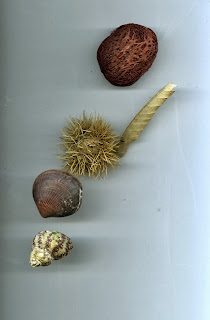
First, i have arranged my objects on the scanner to get the desired image and then scanned it in.

Next, i launched them in Photoshop in order to edit them:
1

  • I have duplicated the "Background layer" to get the "Background - copy" layer.
  • I have set the new layer to "Difference"
  • To get the desired effect, i went to Image > Adjustment > Postersize and set the value to "4"
  • As seen on the "1" print-screen, abnormalities appeared on the screen. I didnt expect it to happen, but i liked the effect.
  • I have resized the "Background - copy" layer to exaggerate the "Difference" effect.
  • I have adjusted the brightness of the background image in the Image menu.
This is the final effect:


3D class - object replica.


A conker i have created in 3D class - its a replica of my original object, made with simple materials: wire and hard foam.
The materials have been the right choice, because the sharp and thin wires have been a good representation of the thorns, with the simillar texture and shape.
Hard foam had a natural colour and was easy to craft, but was more stable than plastescine.

16/9/13 - photoshop lesson

I've drawn an object from my "container of curiosities" using photoshop. I found it rather easy, and the style of it suited the object.
To create the image, i have used various tools and brushes - rubber, brush, layers.
To add shading/light to the object, i have used soft pencils with lowered opacity and to create spikes and edges i have used harder brushes with the opacity set to 100%.
The layers have been used to organise my image - to put the leaf behind the conquer and to add more volume to the spikes and therefore make the image look more 3D.

Wednesday, 18 September 2013

Artist Research - Textiles

Cas Holmes

Holmes uses paper, textiles and mixed media in her work. 
She likes to use discarded or waste material items and develops her pieces using stich and collage.
Her art usually is formed by many layers, including paint, fabric, paper, newspaper, stich and various print. 
Her work can be 2D or 3D, in different forms and shapes such as books.

Mr Finch


Mr Finch is a textile artist who created 3D work using fabric scraps, stitch, found objects and mixed media to create unusual pieces based around nature and animals/insects. Often the size of his art is surreal and over-exaggerated. The colours he uses in his work are usually contrasting or complimentary. 

Val Holmes

A textiles artist, creating art usually nature-themed. Her work usualy illustrates fossils, leaves, trees etc. The colours of her work are usually warm, some contrasting and some tertiary. She often uses collage, stitching one image on top of the other, therefore creating many layers to her artwork. Val uses paper, silk and various fabrics to create her images.

Jennifer Collier

An artist working in a 3D manner, creating objects out of various materials (maps, paper, fabric) with techniques such as stitching, bonding, waxing, trapping and stitching. She re-creates found house-hold objects, vintage and modern. She makes them out of book-pages, magazines, newspaper, paper, card, etc.

Betty Pepper

Simillarily to Jennifer Collier, this artist uses both paper and fabric/stitch in her art. She finds her inspirations in stories, poems and memories, as she states herself. Pepper's material of choice is paper from books or maps and she combines it with stitch, quilting, stitching and using the reverse applique. Her work is usually 3-Dimentional and the colours are tertiary and rather calm.  
Artist research - 3D work

Joseph Cornell


24/12/1903 - 29/12/1972

American sculptor, draftsman and a painter, creating 3D pieces, mostly boxes filled with various arranged objects collected by him. His work usually combined surrealism with constructivism.
Joseph Cornell often created pieces reflecting his own interest, like for e.g. books, reading and things beautiful.
He has also used collage, typography and other mixed media, with mild,tertiary colours.


Henry Moore


30 July 1898 – 31 August 1986
Scupltor and artist, creating art based on surrealism. His most famous pieces were abstract, human-like scupltures made out of bronze. However, he also used plaster and fiberglass. 
Most of his work was quite chaotic, not really detailed and smooth, but some of his work is very complex and detailed, such as a piece called "woman", which was made out of bronze. 

Jim Dine


June 16, 1935 - now

American artist, first a painter/pop-artist, then sculptor. 
His sculpture was generaly made out of bronze and nature-themed or based around man-made objects.
The colours he uses in his work are often abstract, contrasting and intense.
Dine's sculptures were large-sized, up to 9 meters tall.


Peter Randall


July 2, 1954 - now
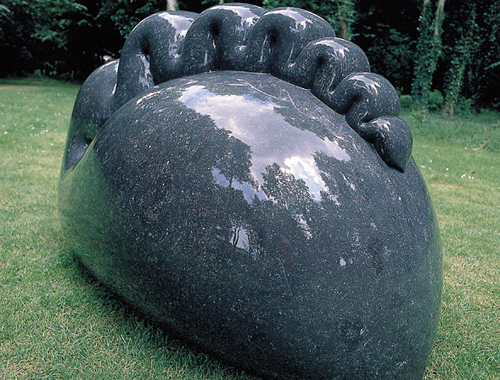
British visual artist and scupltor, who bases his work around natural forms. He also uses natural materials like marble, moorstone and limestone. He usually craves various shapes into his work, creating patterns. He has become the leading artist in the area of sculpturing surfaces.
His art is used as decorations in parks, galeries etc.